

By 70, a Third of Your Muscle Is Gone. Two Workouts a Week Reverse It.
Most men treat muscle loss as a one-way street. A trial of men averaging 78, already frail, already diagnosed, proves it isn't. Here's the evidence and the minimum dose that reverses it.

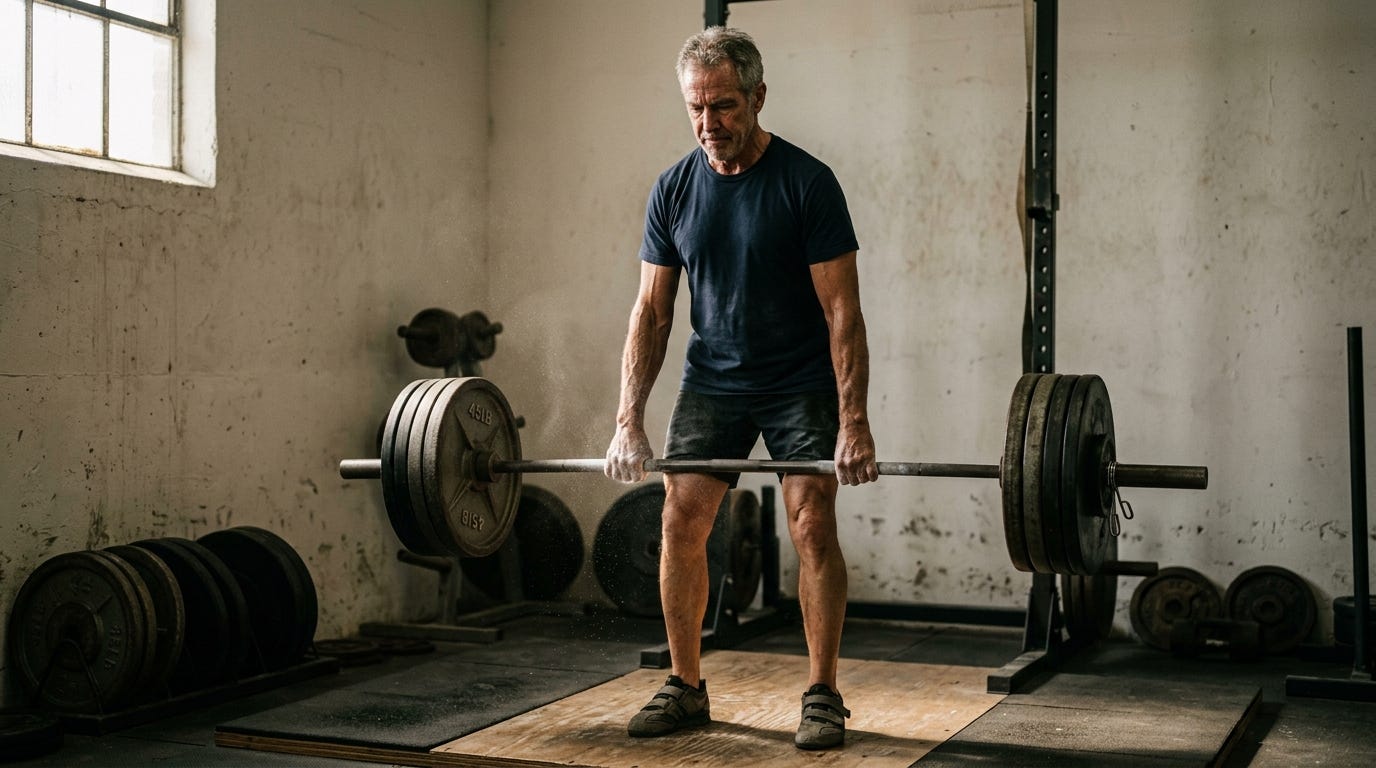
By the time you turn 70, you’ll have lost about a third of the muscle you had at 30. Most of what disappears is the fast-twitch variety. The fibres that catch you when you trip. The fibres that get you out of a chair without. The fibres that let you carry your grandkid up two flights of stairs without thinking about it. using your hand
Here’s a number that sets the floor: between ages 30 and 60, world weightlifting records held by men drop by roughly 30%. The strongest people on the planet, training daily, eating with intent. They have lost nearly a third of their strength in three decades.
If that’s the floor, the rest of us fall much further. Sitting at desks. Training maybe once a week, if we’re trying. Sleeping six hours. Eating like we still play pickup basketball at twenty.
Think about the oldest man you know well. Your father. A grandfather, a coach, a former boss. Picture him picking up a suitcase. Standing up from a low couch. Watch how long it takes.
That’s not ageing in the abstract. That’s muscle, specifically.
How much of yours is still there?
I train five days a week and do long runs on weekends. I’ve spent the better part of two decades putting my body through things: chemo at six, learning to lift in my twenties, coaching people through every version of “I’m too old to start.” The pattern I keep seeing is this. The men who walk into 70 well are not the ones who did everything right. They’re the ones who kept lifting.
Let me show you what the evidence says about that.
What you’re really losing
The clinical term is sarcopenia: progressive loss of muscle mass and strength with age. After 30, you lose 3-8% of muscle per decade. After 60, the rate accelerates. After 75, you start losing strength at 3-4% per year, and strength declines two to five times faster than mass itself.
Read that twice. You can look the same in the mirror at 65 as you did at 45 and still have lost most of the power that lets you be useful.
The mirror lies. Your grip doesn’t.
And quietly, you’re losing fast-twitch fibers first. These are the explosive ones. The ones that fire when you have to react. The slow-twitch fibers, the ones that keep you walking around the kitchen, stay relatively intact for longer.
That’s why old men trip and break hips. Not because their bones are brittle (though they are). Because the muscles that should have caught them didn’t fire fast enough.
That’s the blind spot.
The bad advice you’ve been given about muscle loss
Most advice given to men over 40 is wrong in a specific way. Walk more. Do some yoga or pilates as the latest trend. Don’t lift too heavy, you’ll hurt yourself. Maybe a little bodyweight stuff.
That advice doesn’t preserve muscle. It barely preserves cardiovascular fitness. Walking is good. It is also nowhere near the stimulus your skeletal muscle needs to remodel.
For the last fifteen years, the gold-standard intervention for sarcopenia has been progressive resistance training. Heavy. Hard. With intent. Not the safe-feeling stuff. The kind that makes you grip the bar and breathe out hard.
The pushback is always the same. I’m too old. I’ll hurt myself. The science is for athletes.
Which brings me to the study.
The FrOST trial: men in their late 70s, twice a week
In 2020, a German research group at the University of Erlangen-Nürnberg published the one-year results of a trial they called FrOST - the Franconian Osteopenia and Sarcopenia Trial.
They took 43 community-dwelling men, average age 78, all of whom had already been diagnosed with osteosarcopenia. Their bones were thinning, and their muscles were wasting. By any conventional measure, the worst-case candidates for getting stronger. Most clinicians would have prescribed walking and supplements.
The researchers randomly split them. Half did supervised high-intensity resistance training. Heavy single sets. Twice a week. The other half stayed sedentary. Both groups got vitamin D, calcium, and whey protein, so the only variable was the lifting.
After 12 months, the training group:
Significantly increased lean body mass (the control group lost some)
Gained thigh muscle, the muscle that decides whether you can get off the floor at 80
Increased maximum hip and leg strength
Improved bone mineral density at the lumbar spine
Had no serious training-related injuries
The effect size for lean body mass was d = 1.17. In study-design language, that’s a large effect. The kind you almost never see in geriatric interventions, where everything tends to nudge by a few percent.
Translation: men in their late 70s with sarcopenia and osteopenia rebuilt meaningful amounts of muscle and bone in two short sessions per week.
If they can do it at 78, with the worst hand to play, you can do it at 45.
What to take from FrOST
I’m not telling you to deadlift 180 kilograms on Monday. The FrOST protocol worked because it was supervised, progressive, and matched to the participants. The principle generalizes. The exact loading does not.
But the principle is what matters: the dose that preserves and rebuilds muscle is heavier and shorter than you’ve been told.
A few things follow.
You don’t need to train six days a week. The men in FrOST trained twice. If you can lift twice a week with real intent, you’re already moving the curve. More is fine if you enjoy it. It isn’t the requirement.
Effort is the variable, not volume. A set of squats taken to within two reps of failure does more for your muscles than three half-hearted sets. If you finish a session still feeling like you could have done a lot more, you should have.
Protein matters more after 40 than before it. The FrOST training group ate roughly 1.5-1.7 grams of protein per kilogram of bodyweight per day. For an 80-kilogram man, that’s about 120-140 grams. Most men over 40 eat closer to 70-80, and they wonder why their recovery is slower than it used to be.
Type II fibers come back if you make them. Fast-twitch fibers respond to fast and heavy, not slow and easy. Add some explosive work where it’s safe: jumps, sledge pushes, fast concentrics on machines. These fibers are use-it-or-lose-it in a way the slow-twitch ones aren’t.
The window is wider than you think. This is the part that surprises men in their 50s and 60s. The FrOST men were, on average, 78 and already diagnosed. They rebuilt. You are not too late. You are not even close to too late.
The boring truth
There’s no biohack here. No fasting protocol. No supplement stack that does what lifting does. No peptide, no NAD+ infusion, no morning sunlight ritual that replaces the stimulus of putting a heavy thing on your back and standing up with it.
This is the part nobody on Instagram wants to sell. Strength training is unsexy. It requires showing up. The results don’t come in two weeks. They come every two years. Then five. Then twenty.
Picture the men who reach 80, still lifting their own suitcases, still able to play with their grandkids on the floor and get up afterwards, still able to live in their own homes. They’re not the ones who did everything right. They’re the ones who did one thing right, consistently, for decades.
That one thing is putting their muscles under load.
The minimum effective dose
Three things, in order.
Two strength sessions a week, minimum. Compound movements: a squat or leg press, a hinge (Romanian deadlift, hip thrust), a press, a pull. Take each working set to within two or three reps of failure. Stop chasing soreness. Chase progress on the bar.
Get to 1.6 grams of protein per kilogram of bodyweight, daily. Not on training days. Every day. Spread across three or four meals.
Sleep seven hours. Muscle protein synthesis lives or dies in sleep. This is the variable men ignore the most. It costs you everything.
That’s it. Boring on purpose. Useful, not ornamental.
Common questions about muscle loss and ageing
How much muscle do you lose as you age?
Roughly 3 to 8 percent per decade after age 30, accelerating after 60. After 75, strength declines about 3 to 4 percent per year, faster than muscle mass itself.
Is it too late to start strength training at 60 or 70?
No. In the 2020 FrOST trial, men averaging 78 with diagnosed sarcopenia and osteopenia significantly increased lean body mass, strength, and bone density over 12 months, while training just twice a week.
How often should a man over 40 lift to preserve muscle?
Two hard resistance sessions per week is the effective floor. Training effort and progressive load matter more than total volume.
How much protein preserves muscle after 40?
Roughly 1.6 grams per kilogram of bodyweight per day, spread across three or four meals.
Next in this series: sleep. Why the recovery window determines whether lifting and protein actually build anything, and what changes for men past 40. If you’re trying to hold the line, that one’s for you.
If you’ve talked yourself out of lifting because you’re worried about getting hurt, or you’ve been told to “take it easy” as you get older, I’d like to hear what’s keeping you there. Reply or drop a comment. I read everyone.
Truth over trends. Lift the heavy thing.